
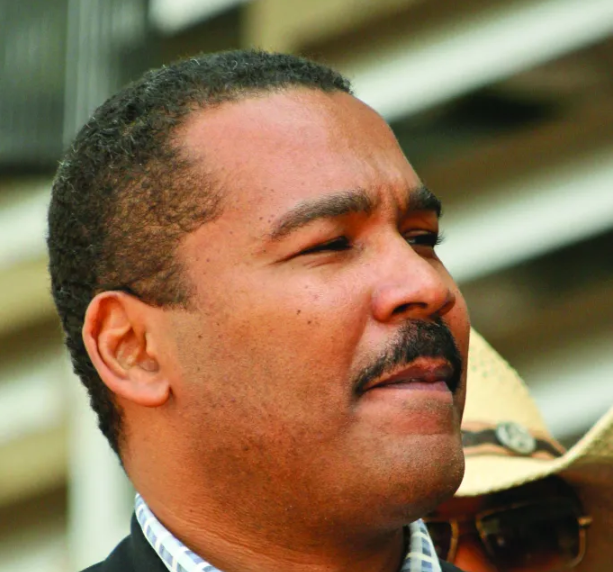

Dexter Scott King, the younger son of the Rev. Martin Luther King Jr. and Coretta Scott King,
by AP News
Dexter Scott King, the youngest son of civil rights icon Dr. Martin Luther King Jr., has passed away at the age of 62 after a battle with prostate cancer, according to statements from his family and the King Center.
The King Center, in a statement, confirmed that the civil rights activist died peacefully in his sleep at his home in Malibu, California, surrounded by his wife, Leah Weber King.
Weber King expressed that Dexter “transitioned peacefully in his sleep at home with me in Malibu,” adding, “He gave it everything and battled this terrible disease until the end. As with all the challenges in his life, he faced this hurdle with bravery and might.”
Dexter, the third child of Dr. Martin Luther King Jr. and Coretta Scott King, married Weber King in 2013. He had no children of his own.
In a statement, Dexter’s older brother Martin Luther King III expressed deep sorrow at the loss of his brother, asking for prayers for the entire King family and particularly for Dexter’s wife.
“I am deeply saddened to share that my brother, Dexter Scott King, has passed away. The sudden shock is devastating. It is hard to have the right words at a moment like this. Please keep the entire King family in your prayers, and in particular Dexter’s wife, Leah Weber,” he said.
The Rev. Al Sharpton also expressed his sadness at Dexter’s passing, noting that he takes comfort in the knowledge that Dexter is now reunited with his parents and sister.
Dexter’s mother, Coretta Scott King, passed away in 2006, followed by his sister Yolanda Denise King in 2007.
Atlanta Mayor Andre Dickens also offered his condolences to Dexter’s family, highlighting Dexter’s profound love for his family and his role as a guardian of his parents’ legacies.
“Dexter held various titles—Morehouse Man, humanitarian, Civil Rights activist, and even actor. However, above all, he was a devoted family man,” he said.
Dexter, who was just seven years old when his father was assassinated, had a life that was deeply intertwined with his father’s legacy.
A graduate of Morehouse College, Dexter had a notable career as the chairman of The King Center for Nonviolent Social Change, a nonprofit organization founded by Coretta Scott King in the aftermath of her husband’s assassination. He also served as president of the King Estate, actively continuing his father’s work in civil rights advocacy.
In an interview with CNN, Dexter recounted watching TV with his older brother when a news flash suddenly interrupted, revealing that his father had been shot in Memphis.
“It was an incredibly chaotic and traumatic time,” he expressed adding that carrying his revolutionary father’s name could be both a blessing and a curse.
In 2003, Dexter recalled that some individuals would express their expectations for him to follow in his father’s footsteps.
“People would say, ‘I want you to be just like your father,’ or ‘You should become a minister,’” he recalled.
He co-wrote a book titled “Growing Up King: An Intimate Memoir,” sharing personal insights into his life as the son of one of the most influential figures in American history. Dexter also portrayed his father in the 2002 film “The Rosa Parks Story,” further cementing his connection to his father’s enduring legacy.
Beyond his civil rights work, Dexter was known for his advocacy of veganism and animal rights. In a 1995 interview with The Vegetarian Times, he expressed how his diet reflected his commitment to nonviolence, stating, “There is a connection between how you live life and how you treat others. It starts with the individual.”
Dexter Scott King leaves behind a legacy of dedication to his family, his father’s work, and his advocacy for nonviolence and animal rights. His contributions will be remembered and celebrated by many who were touched by his life and work.
When to see a doctor
Consider seeing a doctor for prostate cancer if you experience any of the following symptoms or risk factors:
Symptoms: Seek medical attention if they experience symptoms such as:
Difficulty urinating
Frequent urination, especially at night
Blood in the urine or semen
Erectile dysfunction
Pain or discomfort in the pelvic area
Bone pain, especially in the hips, spine, or ribs (which may indicate advanced prostate cancer that has spread to the bones)
Age and Risk Factors: Discuss prostate cancer screening with your doctor, especially if you are:
Age 50 or older (or age 40 for Black men and those with a family history of prostate cancer)
Black, as they have a higher risk of developing prostate cancer
Have a family history of prostate cancer, as this increases the risk of developing the disease
Screening Discussions: You should consider discussing prostate cancer screening with your doctor to make an informed decision about whether to undergo PSA testing and digital rectal exams (DREs). This discussion should take into account individual risk factors, preferences, and potential benefits and risks of screening.
Follow-Up Care: If you have been diagnosed with prostate cancer or have undergone treatment should follow up with your healthcare provider as recommended for ongoing monitoring and management of the disease.
It’s important to be proactive about your prostate health and to consult with a healthcare professional if you have any concerns or if you fall into high-risk categories. Early detection and timely medical intervention can significantly improve the outcomes of prostate cancer treatment.