

By Paolo Pontoniere
“God does not bless any conflict,” wrote Pope Leo in an April 10 post to the social media platform X. “Anyone who is a disciple of Christ, the Prince of Peace, is never on the side of those who once wielded the sword and today drop bombs.”
For the Pope, and increasingly for much of Europe, tensions over the Iran war are not simply a matter of policy difference, but a moral and theological crisis.
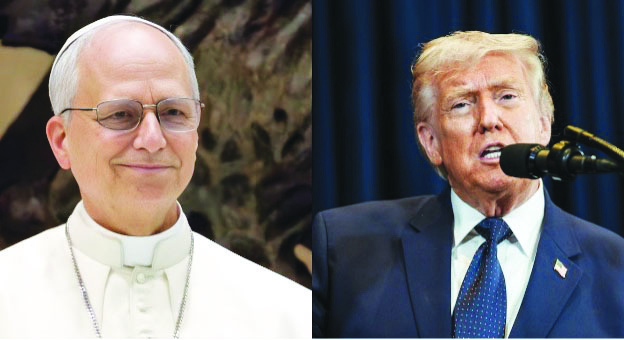
That crisis broke open Sunday when Trump accused the pope of being “weak on crime” and of “catering to the radical left” on his Truth Social account. The normally soft-spoken Leo responded. He told reporters on a flight to Algeria, “I have no fear, neither of the Trump administration, nor of speaking out loudly about the message of the Gospel.”
The tit-for-tat exchange between the American president and the pontiff is the latest in a widening rift between the Vatican — and much of Europe — and Washington DC over the Iran conflict and US policy more broadly.
In January Pentagon officials told the Vatican’s U.S. Ambassador, Cardinal Cristophe Pierre, “The United States has the military power to do whatever it wants in the world.” Another official reportedly raised the issue of the Avignon Papacy, during which the 14th Century French crown used its military might to bring Rome to its knees.
Pope Leo — the first ever American pope — took the message for what it was, canceling a planned visit to the US later in the year.
Then came Trump’s threat, posted Easter morning to Truth Social, to wipe out Iran’s civilization. “A whole civilization will die tonight, never to be brought back again,” Trump posted. The comments drew widespread condemnation, including from some of the president’s longtime conservative backers.
The ‘ideology of profit’
Church leaders alongside European media increasingly interpret these developments as evidence of a broader schism. For many, the divide is over not just policy but fundamental values.
On one side is a vision rooted in Catholic social teaching: universal dignity, solidarity with migrants, and strict moral limits on the use of force. In his Easter address, Pope Leo delivered comments seen as veiled criticism of U.S. foreign policy. The pope warned against what he called the “idolatry of profit,” which he said “plunders the earth’s resources,” and which is at the root of the “violence of war that kills and destroys.”
When “power politics and economic interests take precedence over international law and human rights,” the French paper Le Monde noted, conflict becomes a persistent, structural issue rather than an anomaly.
The Financial Times cautioned that the kind of Christian nationalism fueling parts of Trump’s MAGA base “combines religion and authority in a way that threatens plurality.”
That interpretation, which seeks to bind Christianity to a conservative, nationalist political identity, was laid bare in remarks during a recent White House event by Trump’s spiritual advisor, Paula White-Cain, who likened the president to Jesus Christ. This past weekend Trump also posted an image to his social media platform depicting himself as a Christ-like figure.
America’s moral framework
For the influential Jesuit publication America Magazine, the debate over which interpretation of Christianity prevails revolves around the question of whether Catholics will “accommodate… authoritarian power.”
There is no shortage of historical examples of the Church’s past support for authoritarian rulers, from Spain’s Franco to the military regime that ruled Argentina from the late ‘70s to early ‘80s. Leo’s predecessor, Pope Francis, faced questions over his own ties to Argentina’s dictatorial government.
But in recent years the Church has emerged as a leading voice championing the rights of immigrants, for example, and the importance of participatory democracy.
Church officials in the US have increasingly voiced criticism of Trump’s immigration enforcement tactics, including comments from Cardinal Joseph Tobin, Archbishop of Newark, New Jersey, who called Immigration and Customs Enforcement a “lawless organization.”
With the November midterms approaching, there is a growing sense across much of Europe that the elections are more than a referendum on Trump. For many, they represent a test of America’s moral framework.
And with the Vatican now entangled in a war of words with the president, the question of the Church’s role in shaping US voters’ decisions takes on added importance.
Catholics make up around 25% of the U.S. electorate and are evenly split among Republicans and Democrats, making them a decisive swing vote. Forty percent of immigrants in the US — a constituent that helped secure Trump’s 2024 election win — also identify as Catholic.
Catholics have been a key voting bloc for Trump, but polling from March — before Trump’s latest clash with Leo — finds his support shrinking, with 48% approval compared to 52% who disapprove of his performance in his second term. Those numbers are a reversal from an earlier poll that found 52% of US Catholic voters approving of the president and 48% disapproval.
But for the Vatican, the stakes extend well beyond U.S. politics or the electoral contest itself. At issue is Christianity’s role in public life and whether it remains a universal moral framework or a vehicle for consolidated state power and perpetual conflict.