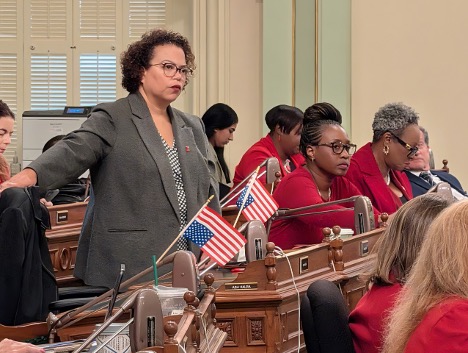

Rasheed Ali and his wife, Gayle Nicholls-Ali, are longtime Altadena residents who lost their home of more than 30 years in the Eaton Fire on Jan. 7, 2025. They support California State Sen. Scott Wiener’s (D-San Francisco) SB 982, the Affordable Insurance and Recovery Act (AIR Act). The legislation addresses rising home insurance costs following catastrophic events, such as the 2025 Los Angeles fires. Behind the Alis are Wiener, Asm. Sade Elhawary (D-Los Angeles), and Asm. Alex Lee (D-Milpitas). Screenshot.

A mailbox and a citrus tree are the only remaining structures on this property.. Altadena, Calif.. Wendsday, January 8, 2025. Photo by Solomon O. Smith
Antonio Ray Harvey | California Black Media
Survivors of the Los Angeles fires and consumer advocates joined Sen. Scott Wiener (D-San Francisco) at the State Capitol on Feb. 5 to announce Senate Bill (SB) 982, the Affordable Insurance and Recovery Act (AIR Act)
The legislation aims to tackle California’s growing home insurance affordability crisis.
Supporters say SB 982 is critical to improving affordability and stabilizing the insurance market by “shifting the cost of wildfires and other climate-driven disasters from the survivors who are suffering” to the large fossil fuel companies they hold accountable for them.
“With the cost of home insurance shooting through the roof and more and more families getting rejected by private insurers, we have to do everything we can to stabilize the market and boost affordability,” Wiener said.
The AIR Act would authorize the Attorney General to take large oil and gas corporations to court for damages related to climate change-fueled extreme weather disasters, such as wildfires and flooding.
One of the leading opponents of the bill is the Western States Petroleum Association (WSPA), a nonprofit trade group representing companies involved in most petroleum exploration, production, refining, transportation, and marketing across Arizona, California, Nevada, Oregon, and Washington.
“This is a political stunt that will kill jobs and increase costs for consumers ,” WSPA stated to Energy Security and Freedom. “This bill would essentially make oil and gas companies financially liable for every natural disaster impacting California — creating a never-ending web of litigation and claims with no foundation in fact or science.”
Gayle Nicholls-Ali and Rasheed Ali’s home of over 33 years in Altadena was destroyed by the Eaton Fire on Jan. 7, 2025. that ripped through the unincorporated area in Los Angeles County and damaged over 9,400 buildings. The Alis appeared at the State Capitol with the coalition of labor leaders, survivors of climate-driven disasters, and legislators that included Assemblymember Sade Elhawary (D-Los Angeles), a member of the California Legislative Black Caucus (CLBC).
“Altadena is a special community full of talented people rooted in a generational legacy that other neighborhoods strive to be,” Elhawary said. “Seeing how much this affected my family, neighbors, our community, and students was heartbreaking.”
The Alis, who are visual and music artists as well as educators, were abroad celebrating their 43rd wedding anniversary in the Bahamas when they lost their home, cars, and, tragically, decades of artwork.
The couple had home insurance, but the coverage fell far short of what it would take to rebuild. Fortunately, they have received grants and funding through a GoFundMe campaign that has helped them move back into the historical Black community.
“This bill matters because it recognizes that everyday Californians shouldn’t be stuck paying higher premiums, losing coverage, or relying on GoFundMe while these enormous corporations walk away from the damage they caused with no accountability,” Gayle Nicholls-Ali stated.
Many Black Americans secured homes in Altadena primarily during the 1950s through the 1970s, and established a middle-class, historic Black community that became a refuge from nearby redlined, segregated areas. Some of those homeowners had paid off their mortgages long before the Eaton Fires and did not have disaster insurance.
After the fire, some of the affected homeowners moved in with family or found temporary housing in hotels, at short-term rentals, or in trailers. The fire disproportionately affected Black households, with nearly 60% of Black-owned homes in the area sustaining severe damage.
“After the fires, the majority of us were sent to far-flung communities. Why? Because Black people who were middle class, who had owned their homes for 20 to 30 years,” Ali told CBM. “Once their house was gone, destroyed in the fire, we had to apply for apartments.”
Ali added, “People were displaced as far as San Bernardino.”
According to YouGov.com, two in five Americans have homeowner’s insurance (41%), but in California, only 31% of residents have a policy. The state has the lowest rates in the market, lagging behind states like South Dakota (59%), North Dakota (55%), Arizona (44%), Oregon (45%), and Nevada (39%).
YouGov is a leading global online market research and data analytics firm that conducts surveys on politics, public affairs, and brands, relying on a panel of more than 30 million regi
The rate of renters’ insurance coverage is particularly low in California, with just 14% of residents covered. This rate is far below states like the District of Columbia (37%), Idaho (21%), Colorado (19%), Oregon (19%), Nevada (19%), and Arizona (18%).
According to a December 2025 report by the Greenlining Institute, communities of color are significantly more likely to be uninsured or underinsured. Based on recent studies by the non-profit public policy, research, and advocacy organization based in Oakland, about 11% of Black homeowners nationwide are completely uninsured.
In the Golden State, the risk is particularly high for Black, Hispanic, and lower-income homeowners, who are disproportionately represented among those without insurance.
“No one should be pushed out of their home by insurance costs, and the AIR Act will take an important step toward ensuring they won’t be,” Wiener said.